
64 percent of the project's in-kind value committed
11 Mar 2011
-
Sabina Griffith
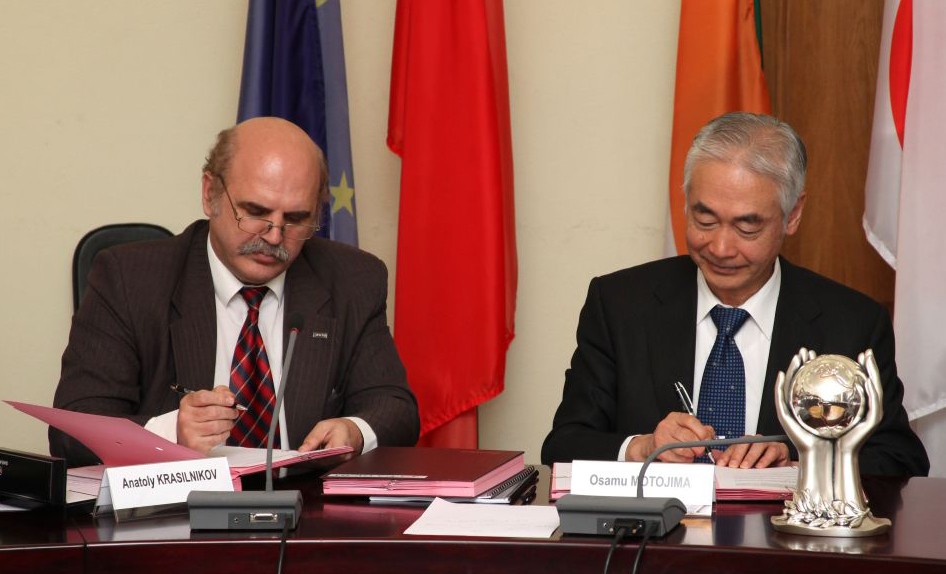
Anatoly Krasilnikov, head of the Russian Domestic Agency, and ITER Director-General Osamu Motojima signing Procurement Arrangement numbers 49 and 50 this week.
This week marked the signing of the 49th, 50th and 51st Procurement Arrangements for the ITER Organization.
On Wednesday, at the Kurchatov Institute in Moscow, ITER Director-General Osamu Motojima and the head of the Russian Domestic Agency, Anatoly Krasilnikov, signed the Procurement Arrangement for poloidal field coil #1.
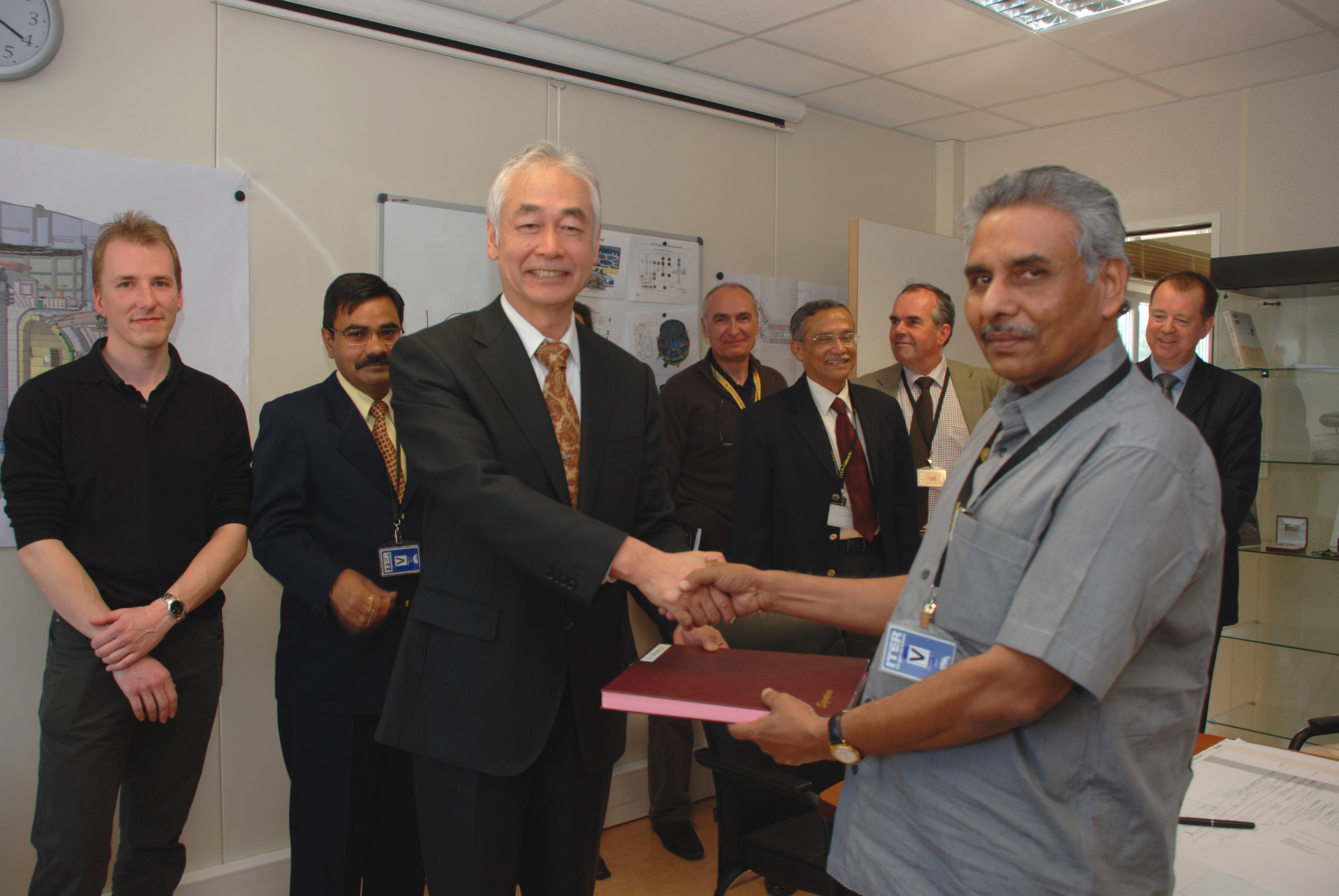
The Procurement Arrangement for the high voltage power supplies was signed with India in the presence of the responsible technical officers and ITER's in-kind management staff. Mr. KGV Nair (right) from the Procurement Division at ITER India accepted the documents from Director-General Motojima and will now take them back with him to Gandhinagar, the homebase of the Indian Domestic Agency.
ITER's poloidal field system consists of six horizontal coils. Coils #2-6 will be procured by Europe in a dedicated 250 metre-long coil winding facility on the ITER site. Coil #1— the smallest of the poloidal field coils (although it weighs a full 293 tonnes)—will be manufactured in Russia under the leadership of the Efremov Institute in St. Petersburg and delivered to Cadarache by boat.
The second Procurement Arrangement signed in Moscow with the Russian Domestic Agency this week, number 50, was for the fast discharge units, switching networks, and the high-current, water-cooled busbars. The fast discharge units are used to protect ITER's superconducting coils in case of a quench. To allay the consequences of such an event, large resistor banks are inserted in the circuits to dissipate the energy stored in the coils that can reach values up to 50 GJ.
The switching networks are used at every pulse for plasma initiation in each of the central solenoid coil packs, and in the circuits of the poloidal field coils #1 and #6. The high-current, water-cooled busbars connect the AC/DC power converters to the switching networks, the fast discharge units and finally to the superconducting coils. The total length of the busbars on ITER will be 10 km for the 21 power supply circuits.
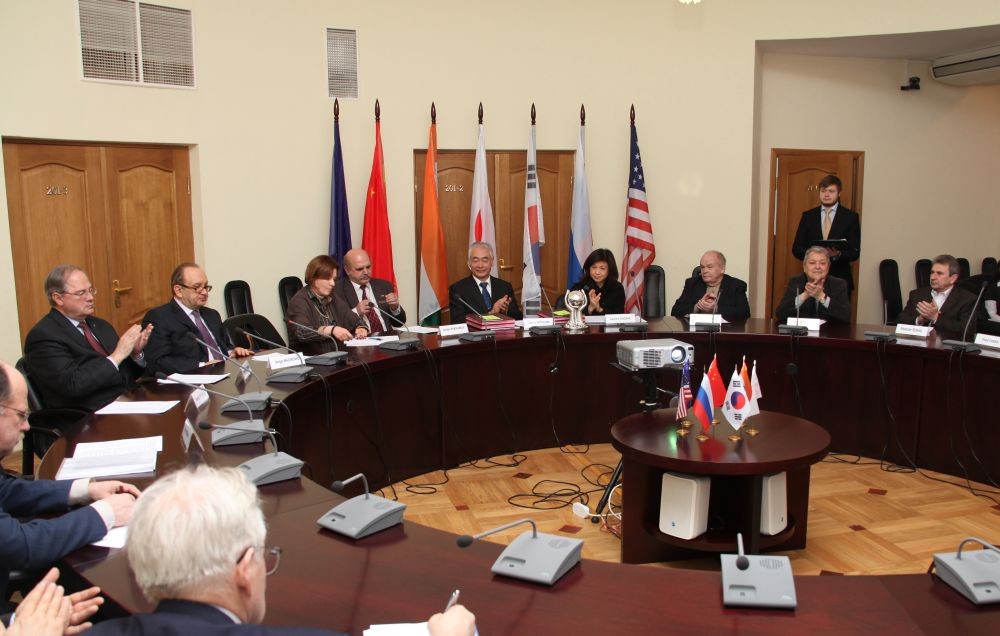
The famous Kurchatov Institute in Moscow was the setting for the signing event this week.
Back from Moscow, Director-General Motojima signed Procurement Arrangement number 51 on Thursday for 8 of the 18 high voltage power supplies for ITER's powerful radio frequency heating system procured by India. In ITER, several heating methods will work concurrently to bring the plasma in the core of the machine to 150 million °C. One of these heating methods is the ion cyclotron heating and current drive system that will inject a total of 20 MW of radio-frequency power to the ITER plasma. The power is generated by nine radio frequency sources similar to standard radio frequency transmitters with 2.5 to 3 MW output power at a frequency ranging from 35 MHz to 65 MHz. The DC electrical power for the 9 radio frequency sources will be provided by 18 high voltage power supply units (AC/DC converters), each delivering 190A, 27kV and 3MW.
Following the signature of these three Procurement Arrangements, the ITER Project's cumulative commitment for in-kind contributions has now reached 64 percent.