
A chronicle of the early ITER days
1 Oct 2012
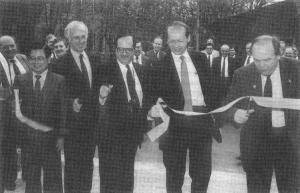
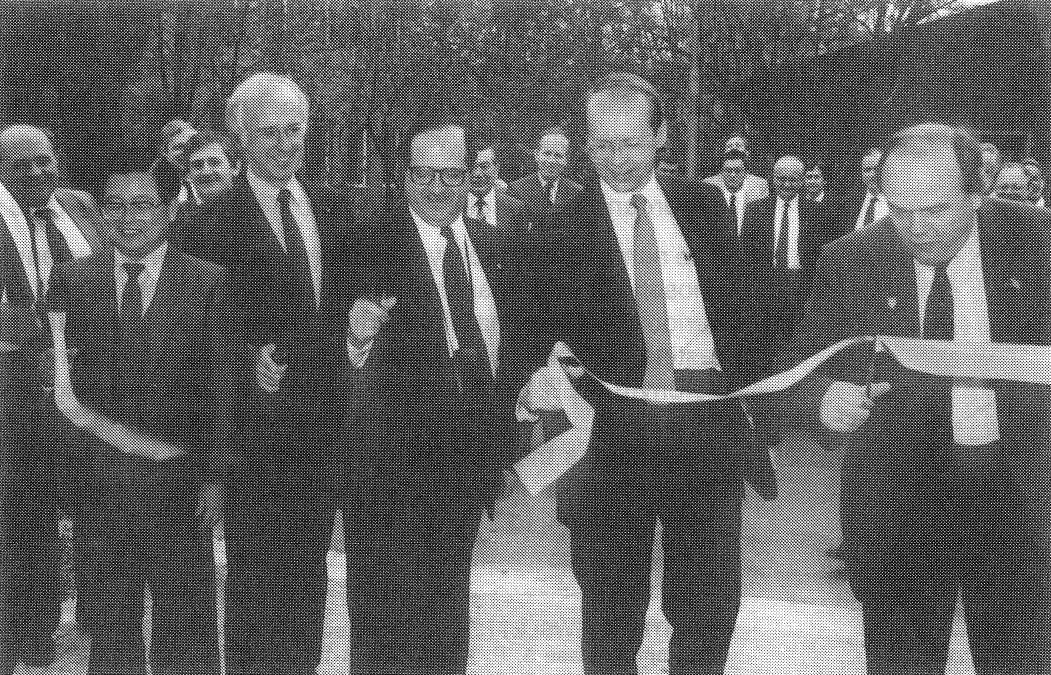
ITER fusion veterans identified: (first row, from left to right) Academician Boris. B. Kadomtsev (USSR); a Japanese official; ITER Council Chair John Clark (USA); IAEA Director General Hans Blix; Director General, directorate for Research and Technological Development (EU) Paolo Fasella; Academician Evgeny Velikhov; and also (second row) Ken Tomabechi, director of ITER CDA activities in Garching; Charles Maisonnier, EU Fusion Program director; R. Toschi; and, half-hidden by E. Velikhov, Neil Mitchell.
Twenty-four years ago, in September 1988, the International Atomic Energy Agency (IAEA) published the first issue of the "ITER Newsletter," an eight-page document that aimed at disseminating information on a nascent international fusion project named ITER.
Next to a rather primitive logo—the flags of the original four partners (the European Community, Japan, the USSR and the USA) arranged in a circle around a radiating Sun—a foreword expressed the essence of the project.
"The task of unravelling the secrets of how to produce useful energy from nuclear fusion has engrossed the minds and directed the efforts of significant segments of the world's scientific community for nearly thirty-five years," it read. "Steady progress has been made, so that today we are approaching an exciting threshold."
The threshold, however, was high, and passing it would require more than the "free and unselfish co-operation of scientists" that had brought fusion to where it stood in 1988. What fusion needed now was a strong political booster and also "major investments in the facilities required to test and demonstrate all the elements of fusion power production."
Three years before, the leaders of many nations had begun recognizing "the scope of the undertaking." President Reagan of the US and General Secretary Gorbachev of the USSR had provided the decisive political boost in November 1985 at the Geneva Summit. Japanese Prime Minister Takeo Fukuda, President Mitterrand of France and British Prime Minister Margaret Thatcher had all "called for increased international co-operation in the development of fusion power."
Now, under the auspices of the IAEA, the time had come to "prepare for a conceptual design for the large scientific/engineering facility" that represented the next logical step in the quest for fusion: ITER, which could be read as the acronym of International Thermonuclear Experimental Reactor but also as the Latin word for "the way" and was to be pronounced "eater." (Almost a quarter of a century later, some argue that ITER should be pronounced "/ɪtə/" with a short "e" rather than "/i:tə/" with a long one.)
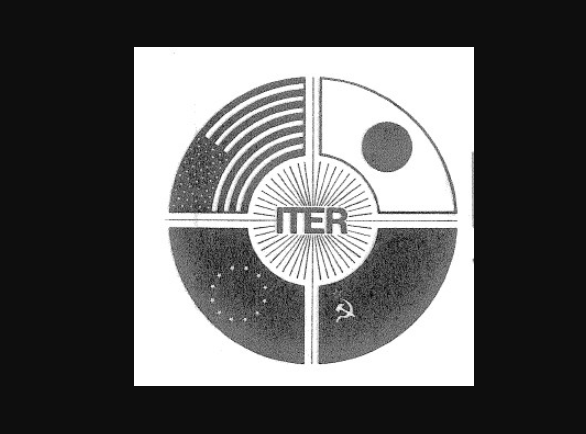
The original black-and-white ITER logo ...
The ITER that was being conceived in 1988 was a much bigger machine than the one that is being built today and its nominal fusion power was expected at 1000 MW, as opposed to 500 today.
For the next ten years, the "ITER Newsletter" reported on the project's scientific, technological, organizational, political and diplomatic progress.
In keeping with ITER Council policy, writing about personal experience was encouraged. Along with physicists, engineers and secretaries, ITER "articulate spouses" would at times write short pieces about the pleasures and hardships of adapting to a foreign environment: learning to be a Hausfrau in Garching in 1988 was no less challenging than being a femme au foyer in Manosque today ...
For the historians of ITER, present and future, the 103 issues of the original "ITER Newsletter" form a treasure trove of scientific and technical information as well as anecdotes on the daily life of an expat community in the last decade of the 20th century.
The "ITER Newsletters" (Sept. 1988-Oct. 1998) are available here.