
F4E signs contract for ITER vacuum vessel sectors
15 Oct 2010
-
Aris Apollonatos, Fusion for Energy
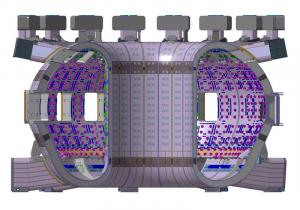
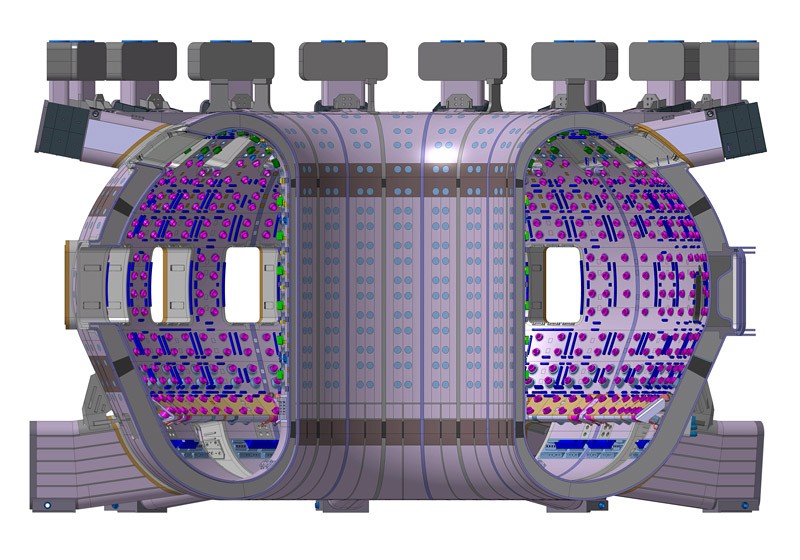
The ITER vacuum vessel will be twice as big and sixteen times as heavy as the vessel of any previous tokamak.
The European Domestic Agency for ITER, Fusion for Energy (F4E), has signed a contract for the supply of seven sectors of the ITER vacuum vessel with the European consortium AMW (Ansaldo Nucleare S.p.A, Mangiarotti S.p.A and Walter Tosto S.p.A). The contract, expected to run for six years, is worth almost EUR 300 million—the biggest single work package of Europe's contribution to ITER.
The complexity of the ITER vacuum vessel, its size, the amount of welding required and the degree of precision that is needed to build the component, brand this contract as one of the most important and technologically challenging of the ITER Project. The in-wall shielding bolted inside the vessel's walls will be delivered by India and ports to be welded on the D-shape sectors will be manufactured by Russia and Korea. Two other sectors of the vacuum vessel will be supplied by Korea.
The ITER vacuum vessel is located inside the cryostat of the ITER device and its basic function is to operate as the chamber that hosts the fusion reaction. Within this torus-shaped vessel, plasma particles collide and release energy without touching any of its walls due to the process of magnetic confinement. The vacuum vessel is composed of nine sectors made of thick special grade stainless steel. Each sector is 13 metres high, 6.5 metres wide and 6.3 metres deep. All of the sectors are similar and are built with double-walls containing the bolted-on shielded plates with a pressured interspace which combine to attenuate the thermonuclear flux so as to avoid overheating of the super conducting coils.
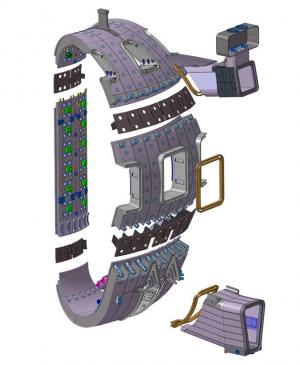
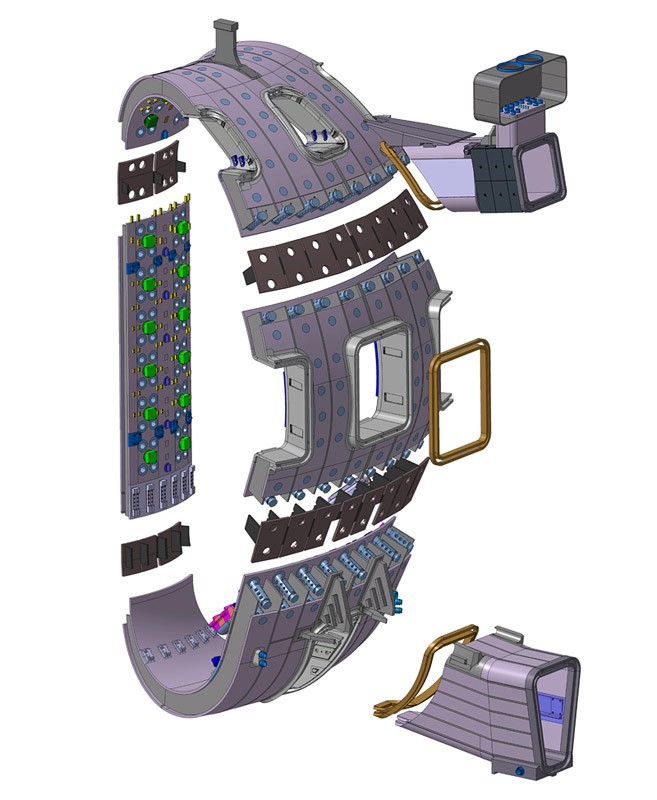
Its double-wall structure is designed to provide a high quality vacuum for the plasma as well as the first confinement barrier for tritium, forming an important part of safety of the ITER device.
The weight of each sector is approximately 500 tonnes and the weight of the entire component, when welded together, will reach an impressive total of 5,000 tonnes (nearly the weight of the Eiffel Tower). The ITER vacuum vessel will be twice as big and sixteen times heavier than in any previous tokamak. Its double-wall structure is designed to provide a high quality vacuum for the plasma as well as the first confinement barrier for tritium, forming an important part of safety of the ITER device. The vacuum vessel will operate at a temperature close to 100 °C and at a nominal water pressure in the inter-space of 11 atmospheres, equivalent to the underwater pressure at 110 metres. The heat of the ITER fusion reactions is removed by the water in the vessel's cooling loops, while the decay heat may also be removed by natural circulation.
The complex doughnut-shape container will be manufactured and put together in segments, following a significant amount of electron beam welding carried out in the largest vacuum chamber in Europe. The ports and segments have to be joined together with unprecedented accuracy for this size of vessel. It is estimated that the total amount of welded joints will add up to approximately 14 km. Europe's proven track record in R&D—with prototypes in ultrasonic testing inspection technology, weld distortion and analysis (including electron beam welding)—and its world class facilities in fabrication technology were essential in undertaking the commitment to provide seven out of the nine sectors of the ITER vacuum vessel.