
Second gyrotron installed on site
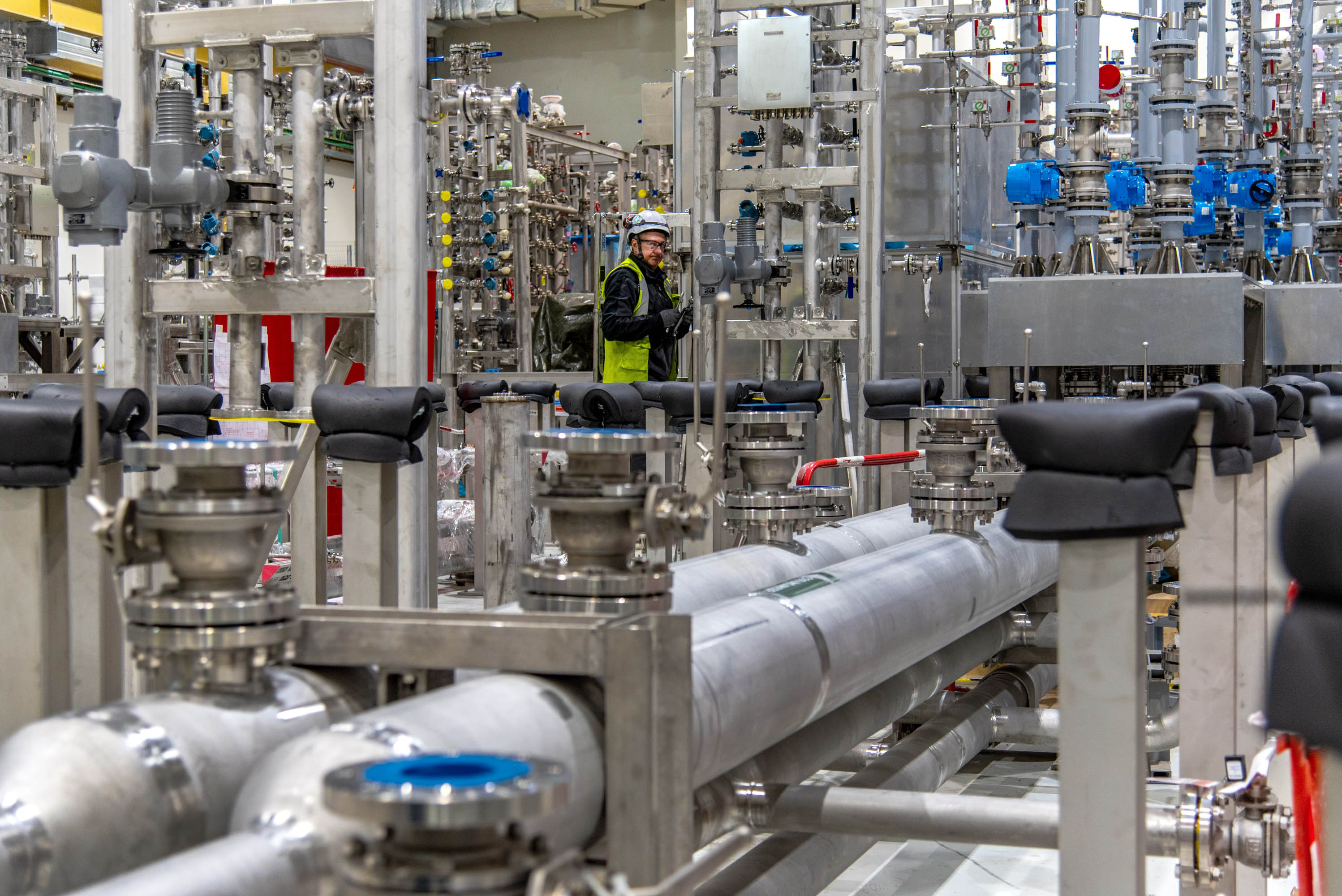
The third level of the Radiofrequency Building is now occupied by a forest of dull grey piping, shining steel manifolds and brightly coloured cables. At the far end of the space, a constant humming is an indication that compressors and chillers are at work, progressively bringing the “super conductive magnet”—an auxiliary system located at the base of the first gyrotron—to cryogenic temperature.
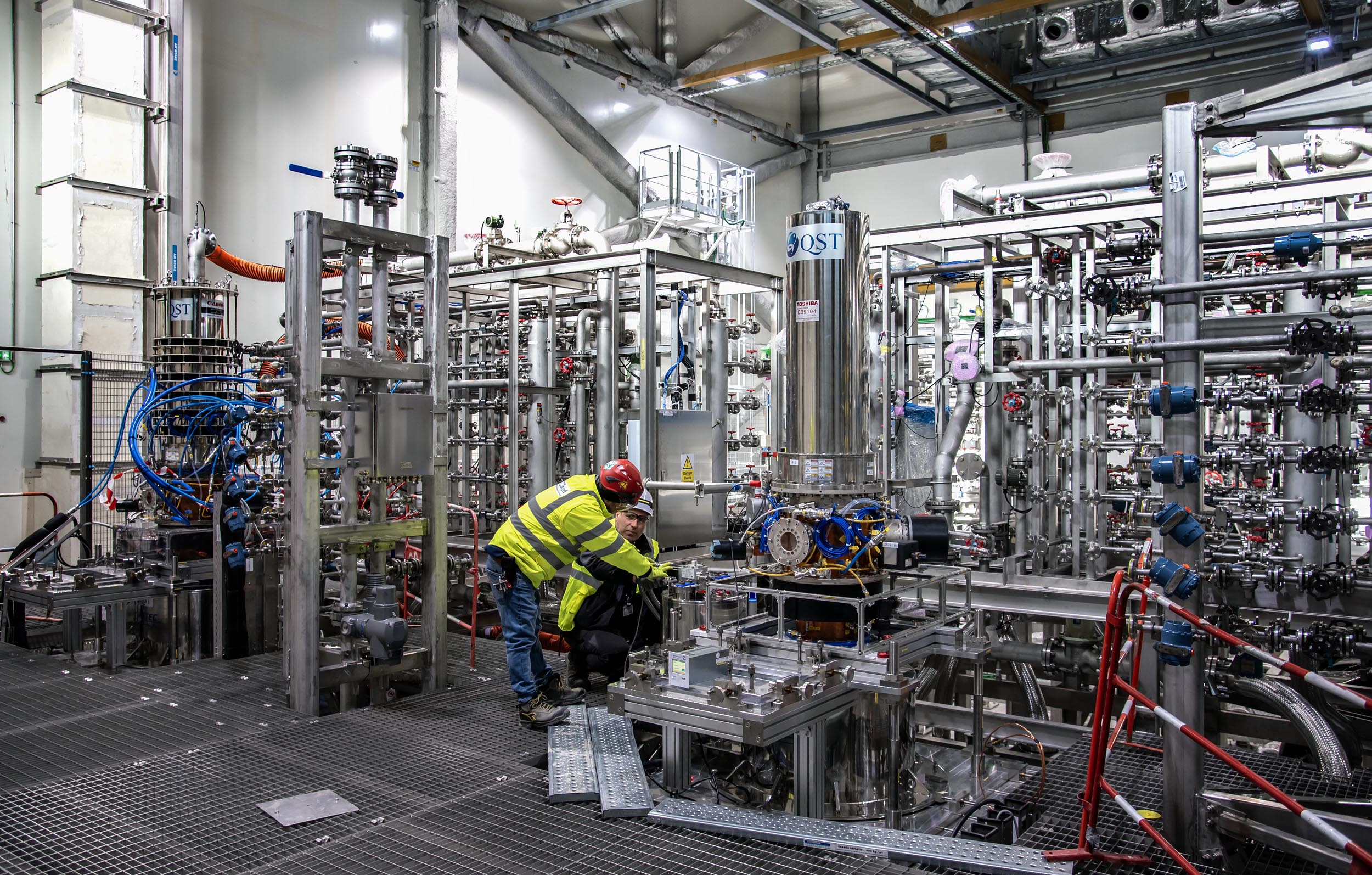
Installed last week, a second gyrotron, also provided by Japan, is now in the early stages of equipment a few metres away. In total, 24 similar devices (8 from Japan, 8 from Russia, 6 from Europe and 2 from India) will be installed on the building’s “gyrotron floor.”
In a gyrotron, electrical power is converted into electromagnetic radiation that “resonates” with the electrons inside the plasma. The resonance effect energizes the particles and contributes to bringing the plasma to the temperatures required for fusion.
Gyrotrons are at the core of the electron cyclotron resonance heating (ECRH) system, one of three external heating systems planned on ITER*.
In the initial ITER research plan (Baseline 2016), the “firing power” delivered by 24 gyrotrons was considered sufficient. In the current baseline (Baseline 2024), more radiowave plasma heating is required and, as a consequence, 48 gyrotrons will be needed at the start of operation, and another 24 for the first phase of deuterium-tritium experiments. An annex to the Radio Frequency Building and a separate building will accommodate this additional equipment.
*Two radiowave-based heating systems (ECRH and ion cyclotron resonance heating, ICRH) as well as the injection of high-energy particles (neutral beam injection) will contribute to bringing the plasma to the temperature at which fusion reactions can occur.