
The switch can now be flipped
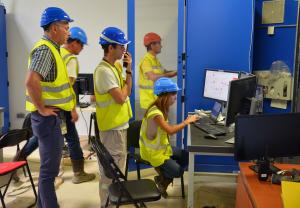
For close to four weeks they tested all the signals, confronting the figures that appeared on their screens to in-field observations and measurements. Transmitted by the CODAC system, more than a thousand pieces of information were checked: position of the switches and circuit breakers, oil temperature in the transformers, pressure, voltages, currents, alarms...
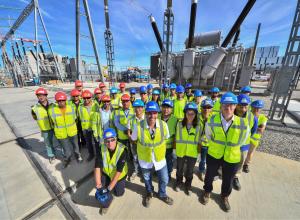

"We needed to be absolutely certain that there wasn't the slightest discrepancy between the information we were receiving and the actual status of the components and systems inside the switchyard and transformers," explains Joël Hourtoule, who heads the ITER Electrical Power Distribution Section.
What was at stake was the energization of the four transformers for the installation's steady-state electrical network (SSEN)—in lay terms, the connection of ITER to the 400 kV French grid, a year-and-a half after the first test was performed in March 2017.
Procured by the US and manufactured by Hyundai in Korea, the massive 160-tonne SSEN transformers decrease the 400 kV voltage fed by the grid to the industrial standard of 22 kV.
The transformers will provide the necessary power to the installation's plant systems and buildings. (A second set of transformers, procured by China, will deliver power to the pulsed power electrical network needed for tokamak operation.)

However the full power of the SSEN transformers will not be needed before actual operations begin. In the meantime, an additional transformer will soon be installed to bring down the voltage from 22 kV to 15 kV, a level of voltage which responds to the needs of the construction worksite and buildings now1.