
Collective strength
Assembly teams are making the connections that link ITER’s toroidal field coils into a unified structure engineered to withstand extreme electromagnetic forces.
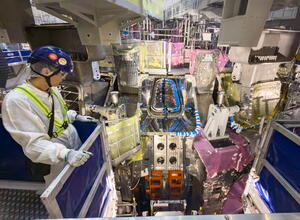
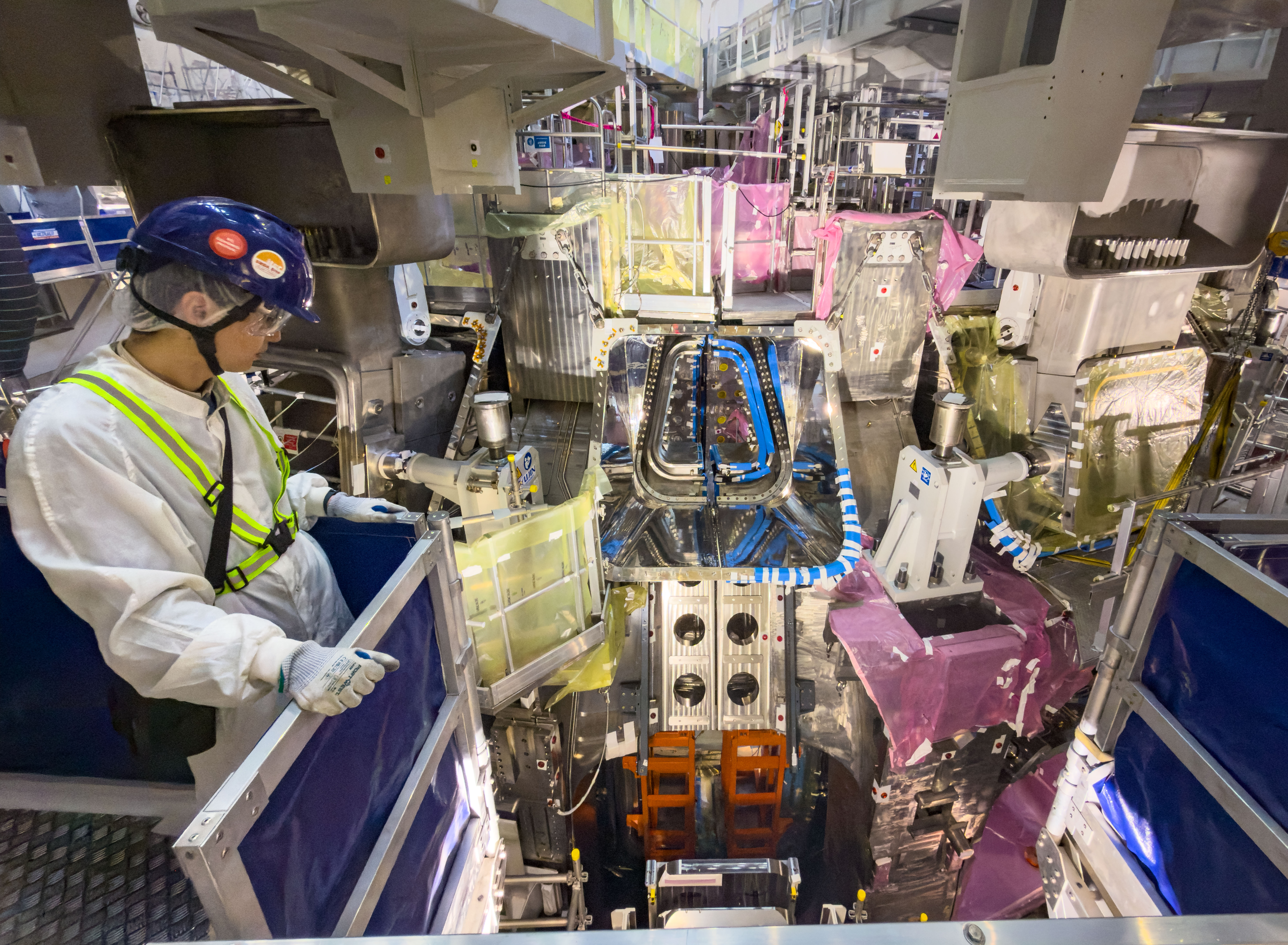
Like the steel hoops that bind the wooden staves of a barrel, ITER’s intercoil connection system links the tokamak’s 18 toroidal field coils into a continuous mechanical framework that prevents coil movement and preserves the magnetic field stability required for plasma confinement. The system is now taking shape as assembly teams complete the first intercoil structures in the tokamak pit.
“This is a crucial step for assembly, and a complex one,” says Christelle Boyer, the ITER magnet assembly engineer, who oversees part of the intercoil connection project. “Intercoil activities must be carefully sequenced with other activities because the connections are being made in highly constrained spaces with very tight tolerances.”
The 18 toroidal field coils of the ITER tokamak generate the magnetic field used to confine the plasma. During operation, the coils will experience electromagnetic loads on the order of several hundred meganewtons—the equivalent of tens of thousands of tonnes of force per coil. To manage these forces, the coils must be connected by an intricate intercoil structure that creates a single mechanical entity capable of resisting shear, compression, and tensile loads.
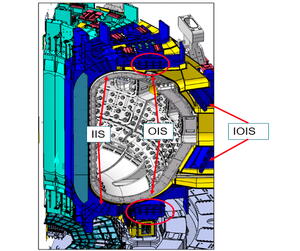
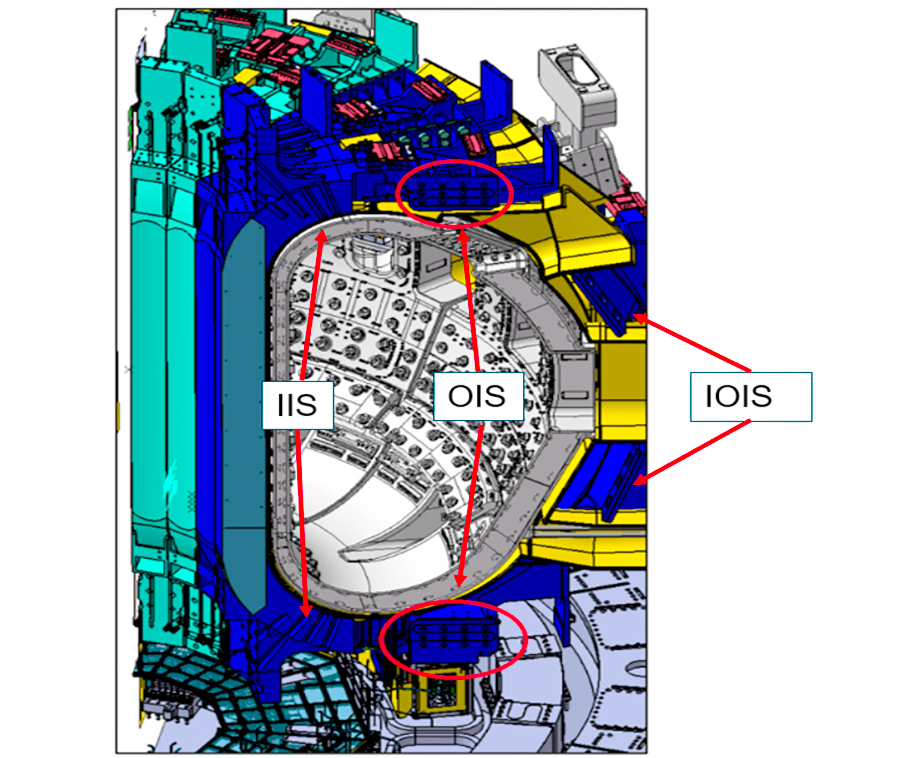
The coils are connected in three distinct zones (see diagram below). On the inboard side, closest to the centre of the machine, two inner intercoil structures (IIS) connect adjacent coils at both the top and the bottom. On the outboard side, outer intercoil structures (OIS) are installed at the top and bottom, while two intermediate outer intercoil structures (IOIS) are positioned at mid-height.
Intercoil connections are executed in two phases. The first connections can be made between two toroidal field coils as they are assembled into a sector module with a vacuum vessel sector and thermal shields in Assembly Hall tooling. Then, as the resulting sector modules are lowered one by one into the tokamak pit, toroidal field coils from adjacent sector modules can be connected. This in-pit phase began at the end of July 2025, as the right-hand toroidal field coil of sector module #7 was connected to the left-hand toroidal field coil of sector module #6.
“The biggest challenge is ensuring the sector modules are aligned properly so the connections can be made,” says Kenji Gomikawa, the ITER assembly engineer overseeing the structural connections in the pit. “These modules are extremely heavy components with connection points that must be matched within a few millimetres of precision.”
The connections are executed using different methods depending on the structure. For the intermediate outer intercoil structure, precision-drilled plates are positioned on either side of the mating surfaces and fastened with high-capacity studs and a pin weighing 300 kg. For the outer intercoil structure, a shim is inserted between the mating surfaces for insulation purposes and then the coils are secured with superbolts, shear bolts, and clamping bolts. These are massive items, with a single superbolt weighing as much as 26 kg.
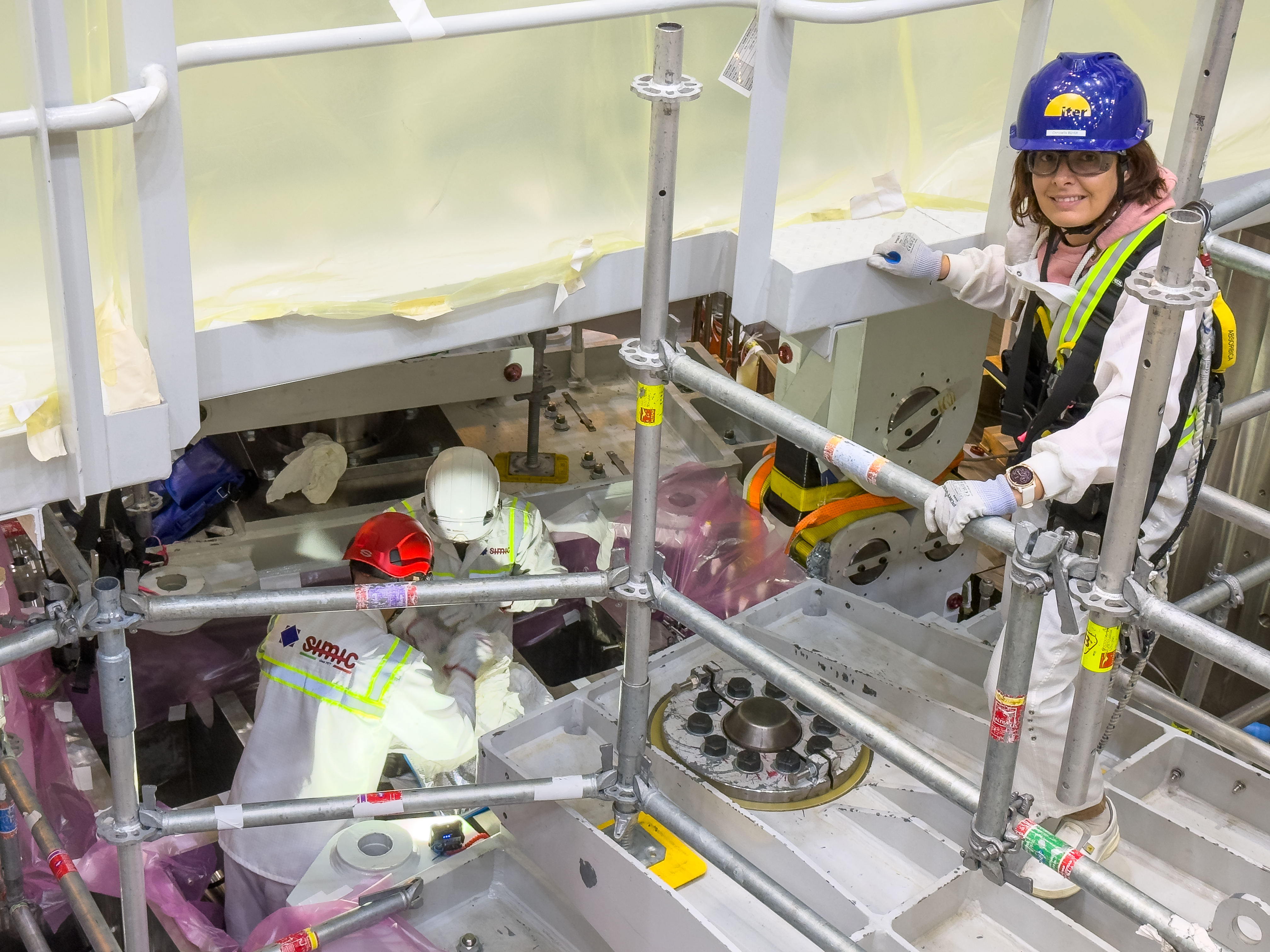
There is, quite literally, no wiggle room. To protect against the immense shear forces generated during operation, the bolts must fit perfectly into the bore holes. In certain cases, specialized “sleeves” are used to compensate for microscopic misalignments. Because these sleeves are produced to fit within a clearance of less than 0.1 mm, they are immersed in liquid nitrogen to contract slightly prior to installation. Once inserted, they expand to achieve a precise fit, ensuring a movement-free connection.
Work is currently underway in the tokamak pit to connect the toroidal field coils between sector modules #6 and #5 and between sector modules #7 and #8. The connections must be completed before sector module #4 is lowered into the pit in the spring of 2026, as its weight will shift the other modules during the landing process and cause the metrology, alignments, and sleeves prepared for the intercoil connections to no longer correspond to the actual position of the toroidal field coils.
Once all sector modules are installed in the tokamak pit and the 18 toroidal field coils are fully connected, the final elements of the magnetic structure—the pre-compression rings—will be installed at the top and bottom of the intercoil assembly to provide additional stability.