
Addressing the challenge of plasma disruptions
13 Mar 2017
-
Michael Lehnen, Scientific Coordinator for the Stability & Control Section
Plasma disruptions are fast events in tokamak plasmas that lead to the complete loss of the thermal and magnetic energy stored in the plasma. The plasma control system in ITER will be responsible for minimizing the number of these events—especially when running high energy deuterium-tritium plasmas—but the probability of disruption will never be zero.
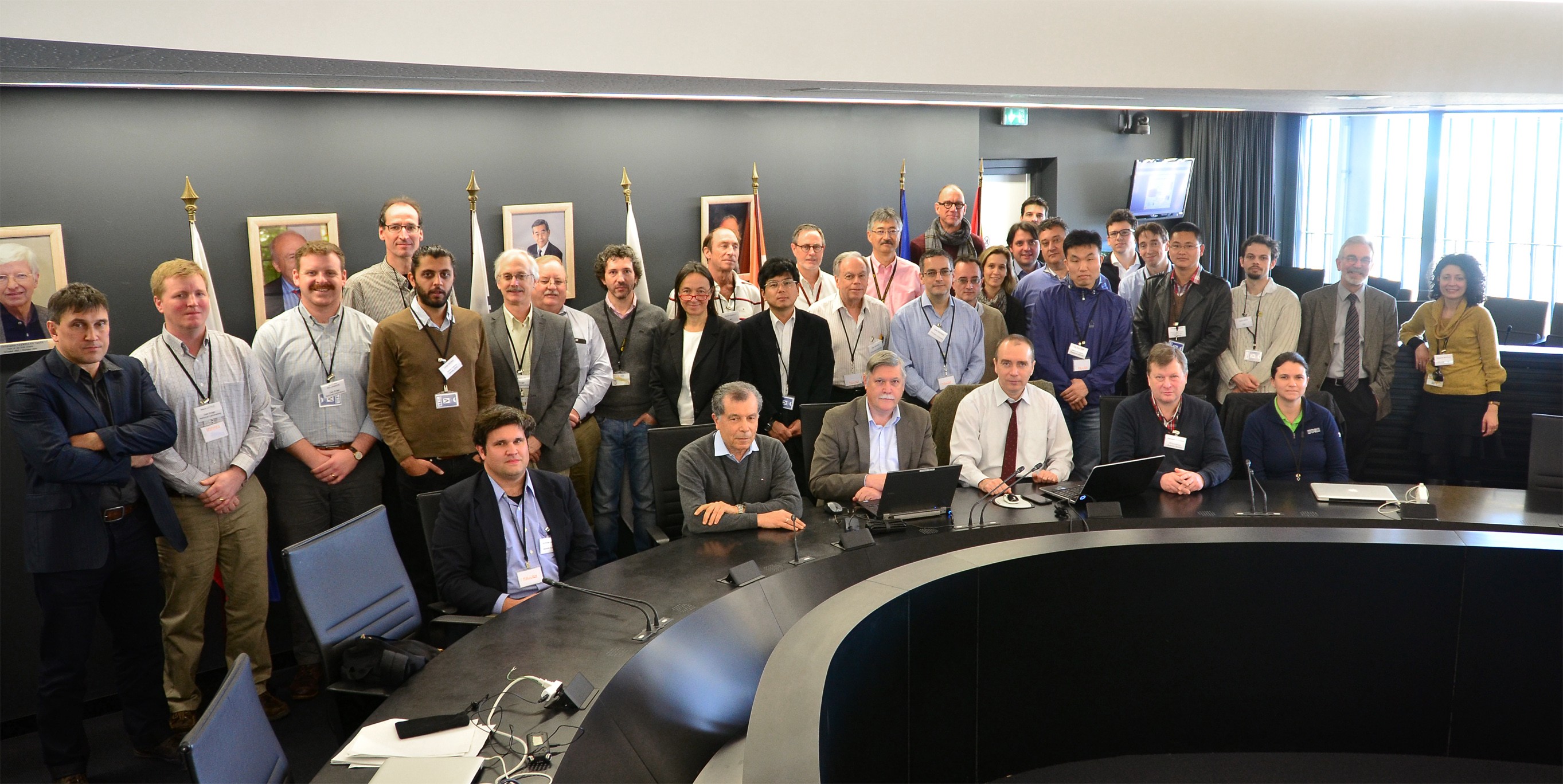
A three-day workshop at Headquarters brought together engineers and physics experts to exchange on designing an effective and reliable disruption mitigation system for ITER. From the most promising approach at present—shattered pellet injection—to alternative injection concepts, the experts had much to discuss.
Therefore, it is essential that ITER be equipped with the right means to reduce the heat fluxes and electromagnetic loads resulting from these events. The central tool will be the disruption mitigation system, whose aim is to inject up to several hundred grams of deuterium and radiating gases like neon or argon. Although these quantities appear small at first sight, they have to be compared to the one gram (at most) of plasma that will be confined in ITER. Moreover, these quantities have to be delivered to the vacuum vessel within only a few 10s of milliseconds to be effective.
But designing an effective and reliable disruption mitigation system for ITER is not only a technological challenge, it also requires a good understanding of the physics mechanisms driving disruptions to allow scientists to predict that a certain design will be effective. This is why a workshop was jointly organized by ITER's Plant Engineering and Science & Operations departments to bring physics experts together with the US ITER engineers based at Oak Ridge National Laboratory (ORNL) developing the design of the disruption mitigation system. About 25 leading experts from the Members' fusion research centres and universities joined the intensive discussions during the three-day workshop from 7 to 9 March.
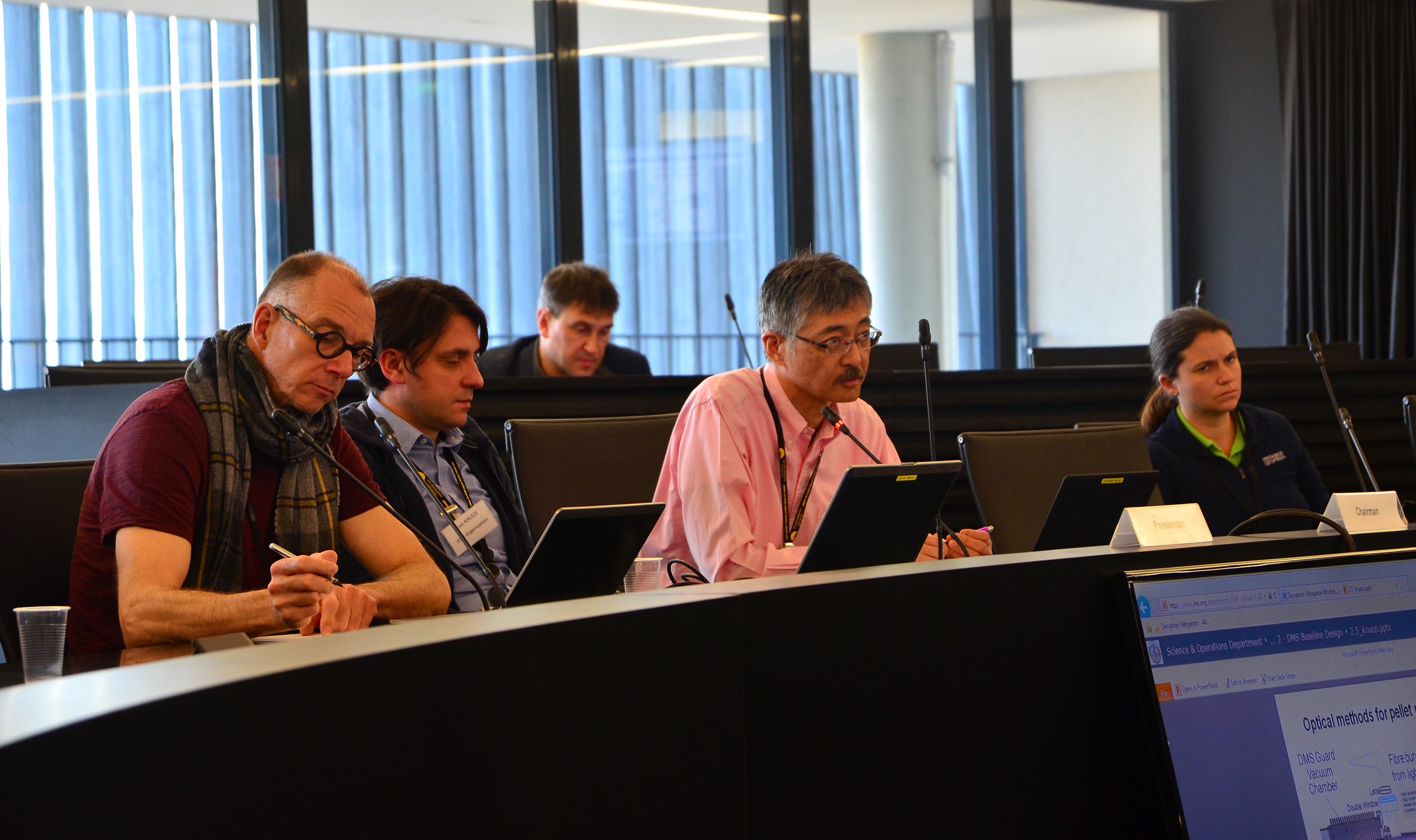
Michael Lehnen (left) from ITER's Stability & Control Section, and So Maruyama (centre), head of the Fuelling & Wall Conditioning Section, coordinated the meeting.
The workshop participants were asked to put ITER-specific engineering constraints aside to have a fresh look at possible concepts for the disruption mitigation system. From the discussion it became clear that the most promising approach at present is to inject the material through shattered pellet injection, which is also the present baseline concept. This technique freezes deuterium, neon, or argon gas to form cryogenic pellets as large as a wine cork. These pellets are accelerated to velocities of up to 500 m/s and broken into shards by a sharp bend at the end of the flight tube. This is intended to ensure that a high fraction of the injected material is assimilated by the plasma.
During the workshop, uncertainties in the design were identified and short-term R&D is planned to address these, including dedicated experiments at the tokamaks DIII-D and JET. But longer term R&D has also been proposed to ensure that alternative injection concepts are at hand should they be required at a later stage in the project.
Due to the complex nature of plasma disruptions, significant gaps still exist in the physics understanding. Most challenging is to understand how the formation of high energy electrons—so-called runaway electrons—can be reliably suppressed during disruptions. This was the central theme and the discussion often came back to this issue. Since a definitive answer will require further research over the next few years, the design of the disruption mitigation system has to be kept as flexible as possible. The urgency for dedicated R&D in this area undeniably exists.
In the coming weeks, the outcome of the workshop will be integrated into a report summarizing the key issues which need to be addressed to improve ITER's disruption mitigation capability. This will be reported to the forthcoming meeting of the ITER Council Science and Technology Advisory Committee in May.