
The path of least resistance
17 Sep 2010
-
Krista Dulon
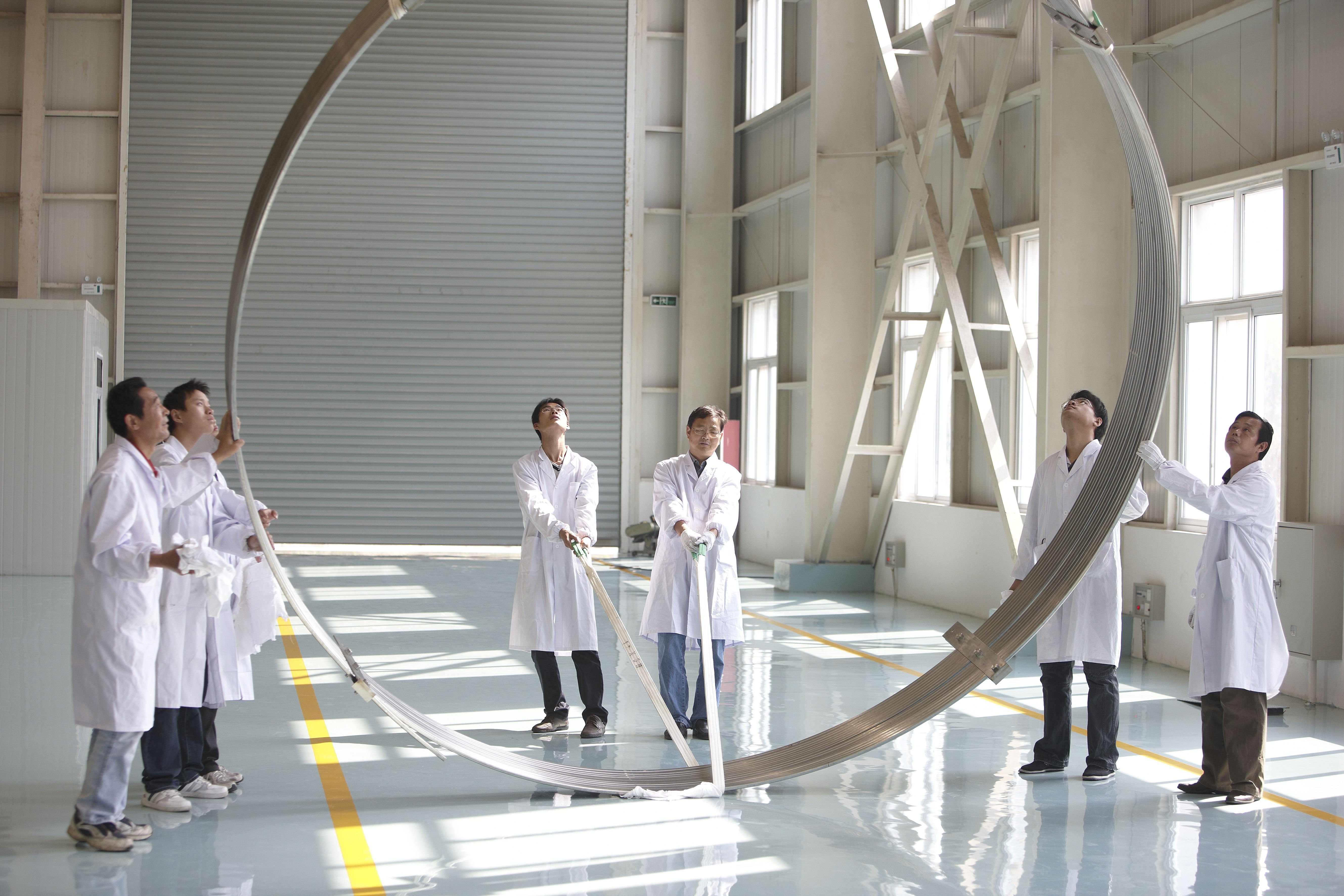
Without superconductivity, ITER would go from being a "net energy positive" machine to a "net energy negative" machine. Here, technicians at the Institute of Plasma Physics in Hefei, haul a model of ITER's superconducting correction coils. © Peter Ginter
Only centimetres away from ITER's 150-million-degree-Celsius "fusion furnace," certain components will be operating at temperatures that are at the extreme opposite end of the scale.
The magnets surrounding the ITER tokamak will be cooled to very low, or cryogenic, temperatures near absolute zero—approximately minus 269 degrees Celsius (4.2 Kelvin). That's colder than the dark side of the Moon or the surface of Neptune, the furthest planet from our Sun.
When ITER's magnets are cooled to -269 °C, they become superconducting.
Superconductivity is a natural property of certain metals, alloys and ceramics when cooled below a defined "critical temperature."
Below the critical temperature—which varies for each material—electrical resistance drops to zero, allowing these materials to carry large amounts of electrical current without losing energy.
In magnets operating at "normal" temperatures, electrical current can be visualized as a flow of electrons moving through a microscopic jungle of atoms, defects and other electrons. The electrons inevitably collide with some of these particles, causing the electrons to lose momentum, and creating heat in the process.
For large magnets, two negative side effects result: more energy is required to restore the lost energy; and the heat generated by the collisions needs to be extracted from the magnet coils.
In ITER, on the other hand, as the superconducting materials in the magnets are cooled to below their critical temperature, the properties of electrons are changed in such a way that this electrical resistance disappears completely, and they become superconductors.
"Typically, when you pour energy into a magnet, resistance steals away part of what you have poured in," explains Paul Libeyre, Central Solenoid and Correction Coil Section Leader. "It's like trying to fill a bucket with water when it has holes. A superconducting magnet can be thought of as a bucket without holes; electrical resistance disappears completely and what you pour in ... you are able to keep."
A question of efficiency
By "retaining" all of their energy, the superconducting materials chosen for ITER's magnet systems will be able to carry higher current and produce stronger magnetic field than conventional counterparts. They'll also consume less power and be cheaper to operate ... making superconducting magnet technology the only option for ITER's huge magnet systems.
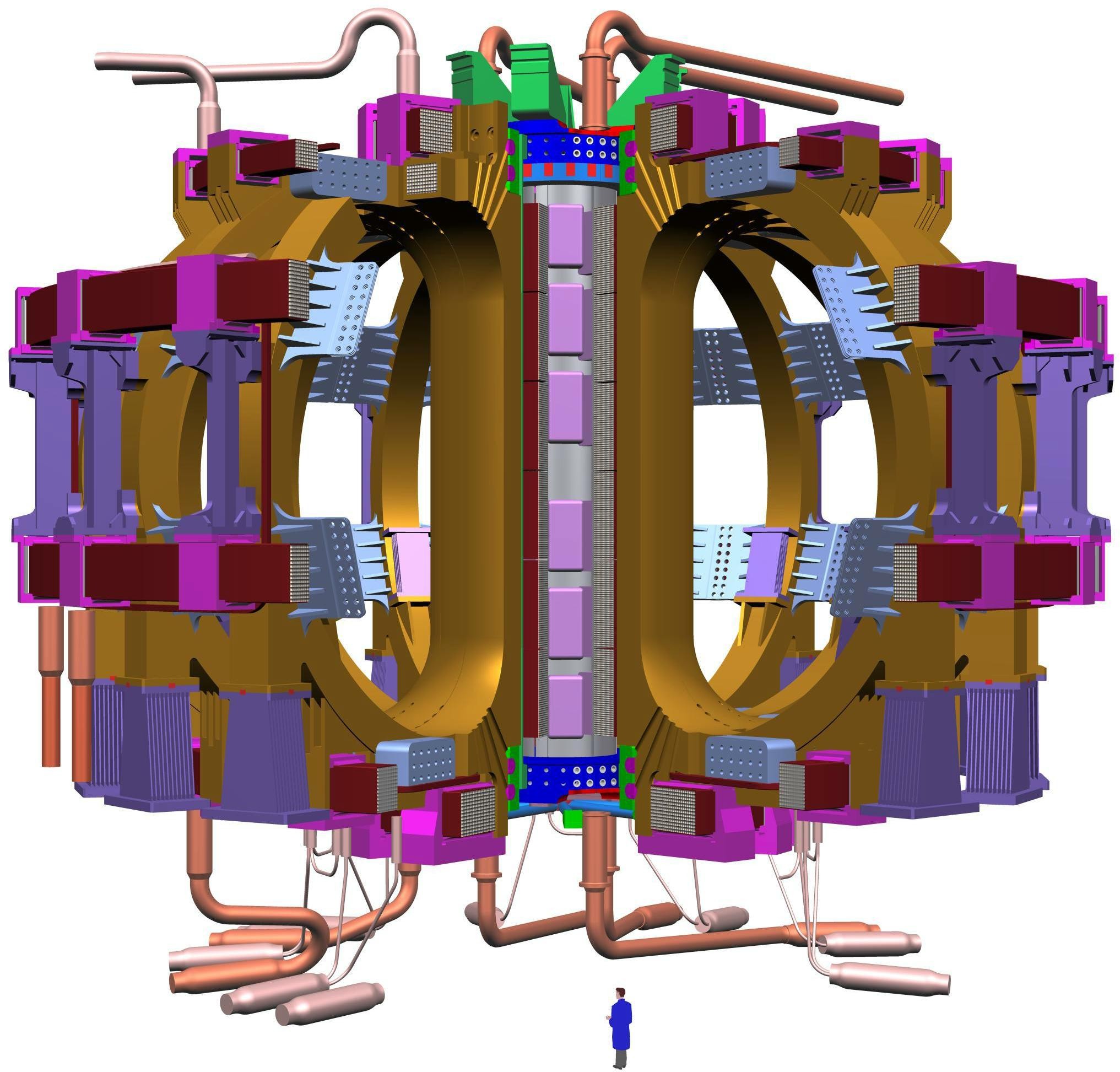
Colder than Neptune or the dark side of the Moon: the ITER magnets will be cooled to -269 °C, and become superconducting.
"With superconductors," says Arnaud Devred, Superconductor Systems and Auxiliaries Section Leader, "the ITER magnets will consume about 35 MW of power, which is mainly needed to run the cryoplant that keeps them cold. Without superconductors, there would be no chance of achieving Q≥10 or even Q≥1."
Advances in superconductivity have made possible an array of energy-intensive applications in the past decades such as magnetic-resonance imaging, magnetically-levitated trains, and particle accelerators.
Most of the superconducting magnets used in these applications are made from a niobium-titanium (NbTi) alloy that offers robust performance at low cost. ITER plans to use NbTi for two of its magnet systems—its poloidal field magnets, and an array of small correction coils.
Above a certain "critical magnetic field," however, NbTi no longer operates as a superconductor. For the ITER magnets that will be required to produce the strongest magnetic field—the central solenoid and the toroidal field coils—the costlier but higher-performing niobium-tin (Nb3Sn) alloy will be used.
Among superconducting tokamaks, Tore Supra in France was the first to test niobium-titanium in its toroidal field system in 1988. EAST in China, commissioned in 2006, was the first fully superconducting tokamak. More recently, niobium-tin (Nb3Sn) superconducting magnets were integrated in the Korean tokamak KSTAR (2008), and in tokamaks under refurbishment (JT-60SA in Japan) or construction (SST-1 in India).
These latest-generation tokamaks will be able to achieve ITER-similar operational parameters; experiments run on these devices will serve to support the operation of ITER, and to investigate how to optimize the fusion power plants of the future.
Story developed with Arnaud Devred, Superconductor Systems and Auxiliaries Section Leader, and Matt Jewell, ITER-Monaco Fellow in the Magnet Division.