
Tokamak Complex
Paint it white
25 Feb 2019
-
R.A.
Room by room, level by level, the raw concrete of the Tokamak Complex is being covered with coats of smooth, shiny white paint. The figures are mind-boggling: in the lowest level of the Tokamak Building (B2) where the teams are working currently, close to 28 tonnes of resin, primer and paint are needed to cover the floor, walls and ceiling of the vast galleries surrounding the central Tokamak Pit.
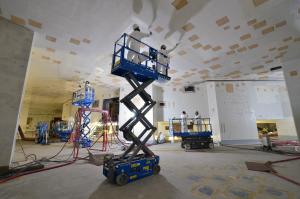
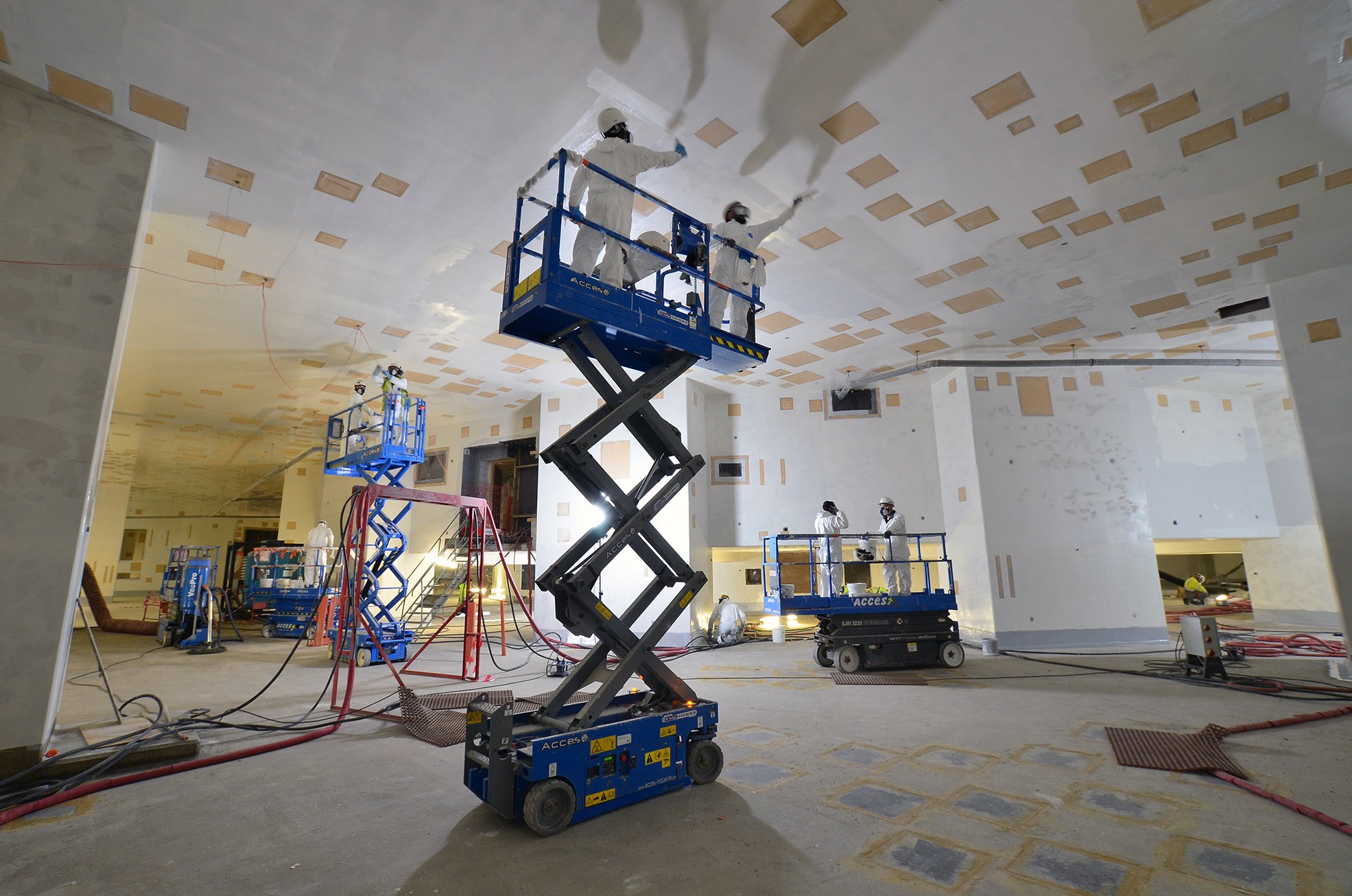
150 tonnes of resin, primer and paint to transform the raw concrete surfaces of the Tokamak Complex into a pristine jewel box.
An equivalent tonnage will be required for each of the other main levels of the concrete building, bringing the total to approximately 150 tonnes. The same treatment will be applied to the inner walls of the Tokamak Pit—a total surface of more than 3,000 m²—and to the Diagnostics and Tritium buildings.
In the Diagnostics Building, paint provides for cleanliness and a dust-free environment. Everywhere else in the Tokamak Complex, it is an element of nuclear safety. In a nuclear building, the coating on the floors, walls and ceilings must present a perfectly smooth surface in order to be decontaminated in case of an incident or accident. (Proven decontamination techniques include water projection, adhesive foam, etc.)
Just like in a home-painting job, surfaces must be prepared and elements such as switches, electrical outlets and door frames must be protected by masking tape. In ITER, these simple tasks take on mammoth proportions: sandblasting the walls and ceiling prior to applying the primer, for example, requires more than 100 tonnes of abrasive material per level, and there are up to 19,000 embedded steel plates per level in the Tokamak Building that require masking.
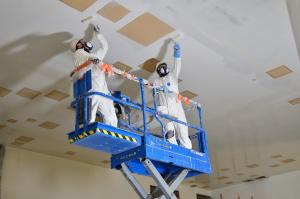
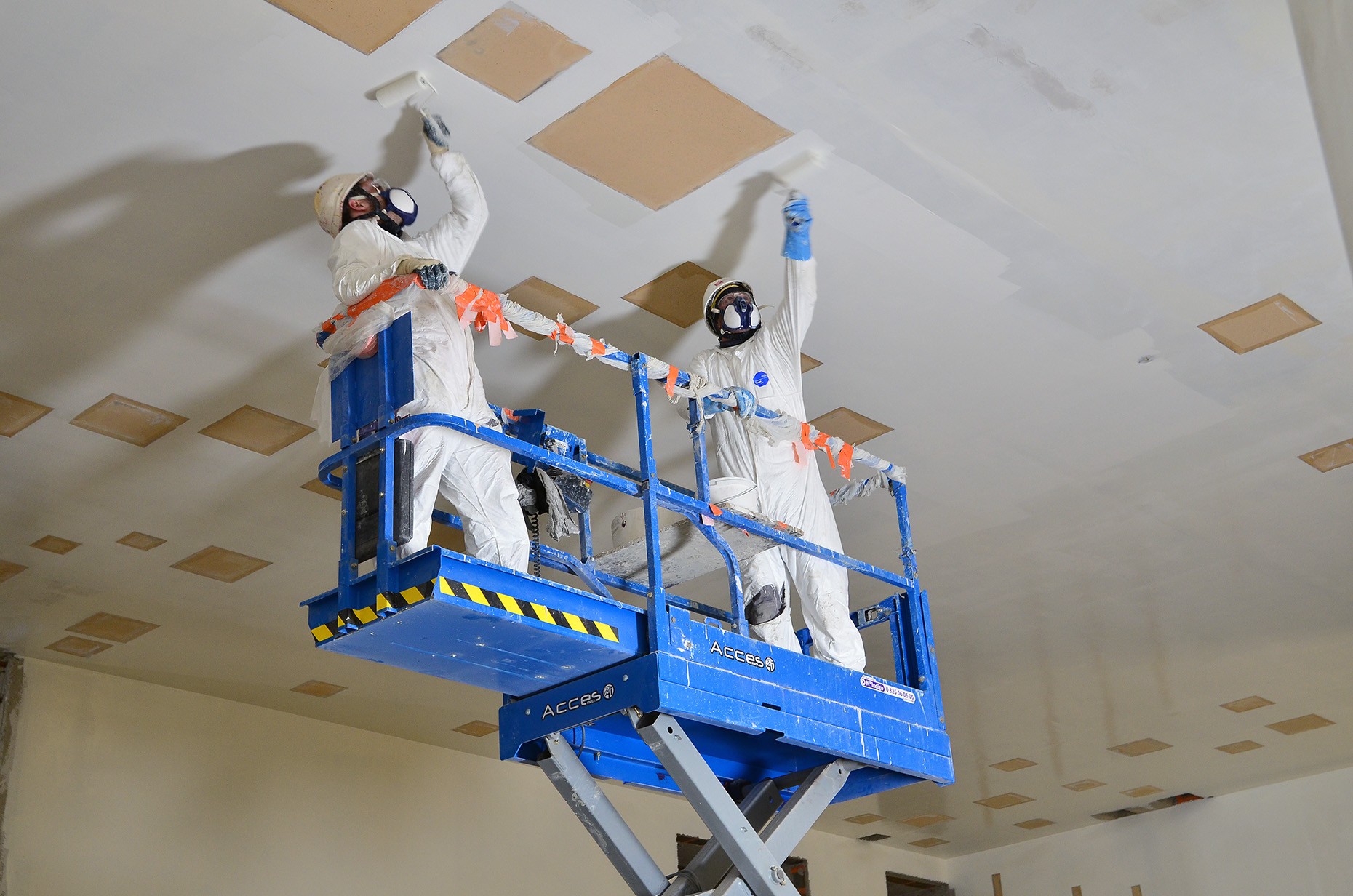
Like at home ... but on a much larger scale. These workers use rollers around the pre-taped embedded plates.
Home painting jobs rarely include floors but in ITER they do—and the quality of the job is paramount in terms of nuclear safety. Floors need to be perfectly leak-tight and act as a "drip tray" in case of a leakage of effluents.
Whereas walls and ceiling are sandblasted to optimize paint adherence, the floors are submitted to the "bombardment" of small steel balls—a technique called "shot peening"—that creates a pockmarked surface facilitating the binding of the first layer of coating to the concrete surface.
The shot-peening operation is followed by the application of a coat of thick primer, followed by four layers of super-smooth resin—not only on the floor proper but up the wall to a height of about 30 centimetres. All in all, a six-millimetre-thick resin coating.
One of the reasons why home paint jobs are preferably done in the spring is air temperature. A balmy 20 °C is ideal, but in the vast volumes of the Tokamak Building this is not easy to achieve—particularly in the Tokamak Pit, whose open volume is in excess of 25,000 m³.
Next week, when painting begins inside this 30-metre high, 30-metre-in-diametre cylinder, the inside temperature will not rise above 10 °C. Teams have planned industrial hot air blowers to progressively bring the temperature to the required 20 °C and maintain it throughout the 2.5-month duration of the works.
The Tokamak Building in raw concrete conveyed a feeling of brute force, consistent with the massive challenges of construction. Once painted white, it will provide a pristine jewel box for the most complex and sophisticated research installation ever built.