
Busbar installation
"Power cords" thicker than train rails
14 Sep 2020
Connecting an electrical device to a power source requires an extension cord, generally made of stranded copper wire. Depending on the required current intensity—are you plugging in a bedside lamp, a washing machine or an arc welder?—the cord's section ranges from a few millimetres to more than one centimetre. In the ITER magnet system, where huge components need to be fed with intense DC current, the equivalent of the electrical cord is a "busbar." The largest ITER busbars are thicker than a train rail and can carry current 7,000 times more intense than a heavy-duty electrical cable.
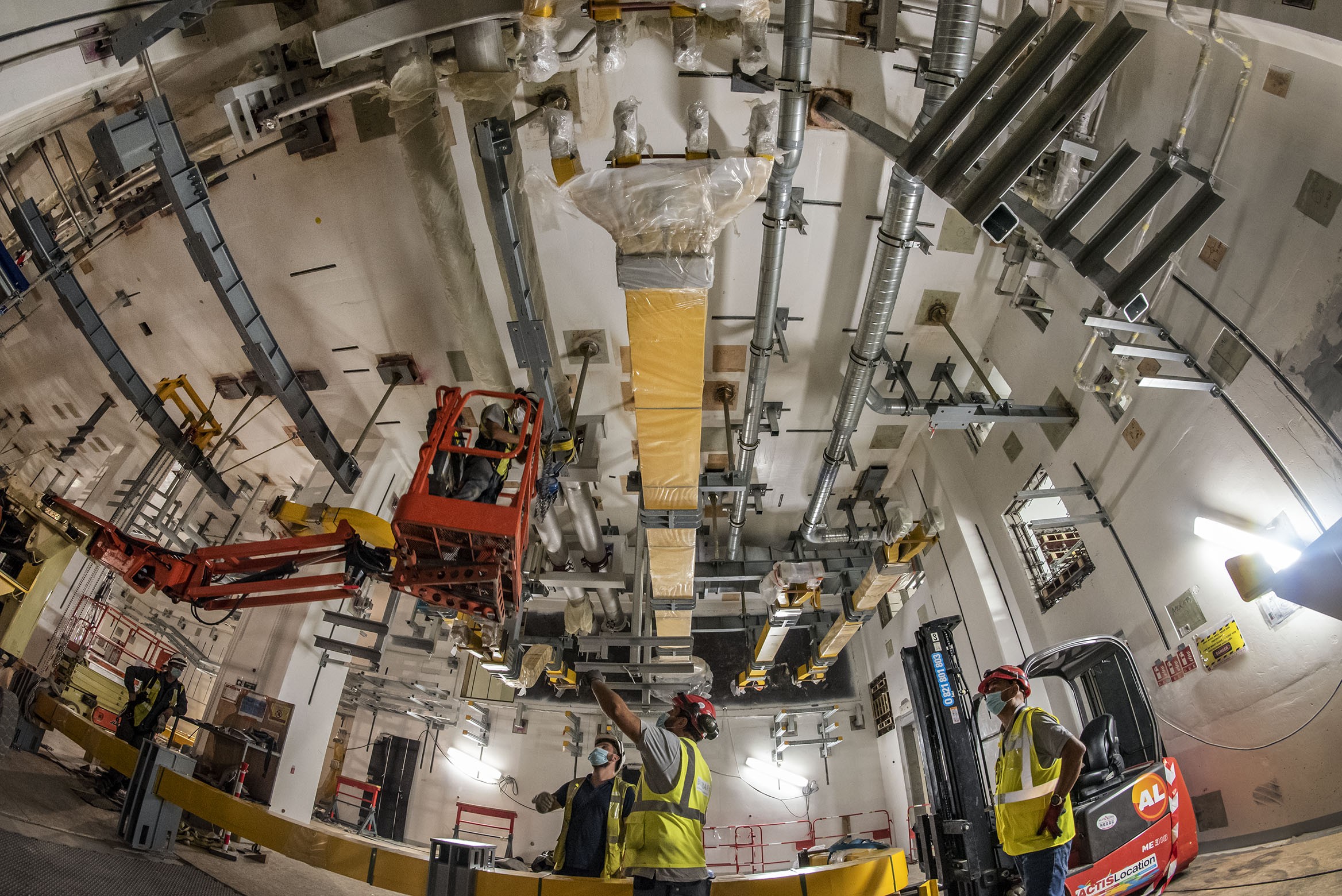
A busbar is to an ITER magnet what an extension cord is to a bedside lamp—a way to connect an electrical device to a power source. In ITER, the largest busbars are thicker than a train rail and can carry current 7,000 times more intense than a heavy-duty electrical cable.
Busbars are steel-jacketed aluminium bars actively cooled by a constant flow of pressurized water. There will be close to five kilometres of DC busbars—amounting to 500 tonnes of material—in the ITER installation, all procured by Russia.
The busbar network originates in the twin Magnet Power Conversion buildings, where AC current from the grid is converted into DC current suitable for the magnet system. The canary-yellow-lacquered bars exit the buildings through "mezzanines" and pass over two 50-metre-long bridges to the Tokamak Building, where they snake under the ceiling to reach their hungry "clients": the machine's 18 toroidal field coils, 6 poloidal field coils, 18 correction coils and 6 central solenoid modules, plus the switching network unit for the initial plasma boost and the fast discharge unit that will deal with possible quench events.
In the twin Magnet Power Conversion buildings, the installation of approximatively 1.25 kilometres of busbars is almost complete. The focus now is on the Diagnostics Building's basement level (B2) where teams are busy bolting busbars to their supports anchored in the ceiling.
Busbars at the basement level are for all 18 toroidal field coils, which are connected in series, poloidal field coils # 4, 5 and 6, the three lower modules of the central solenoid and a set of side and bottom correction coils.
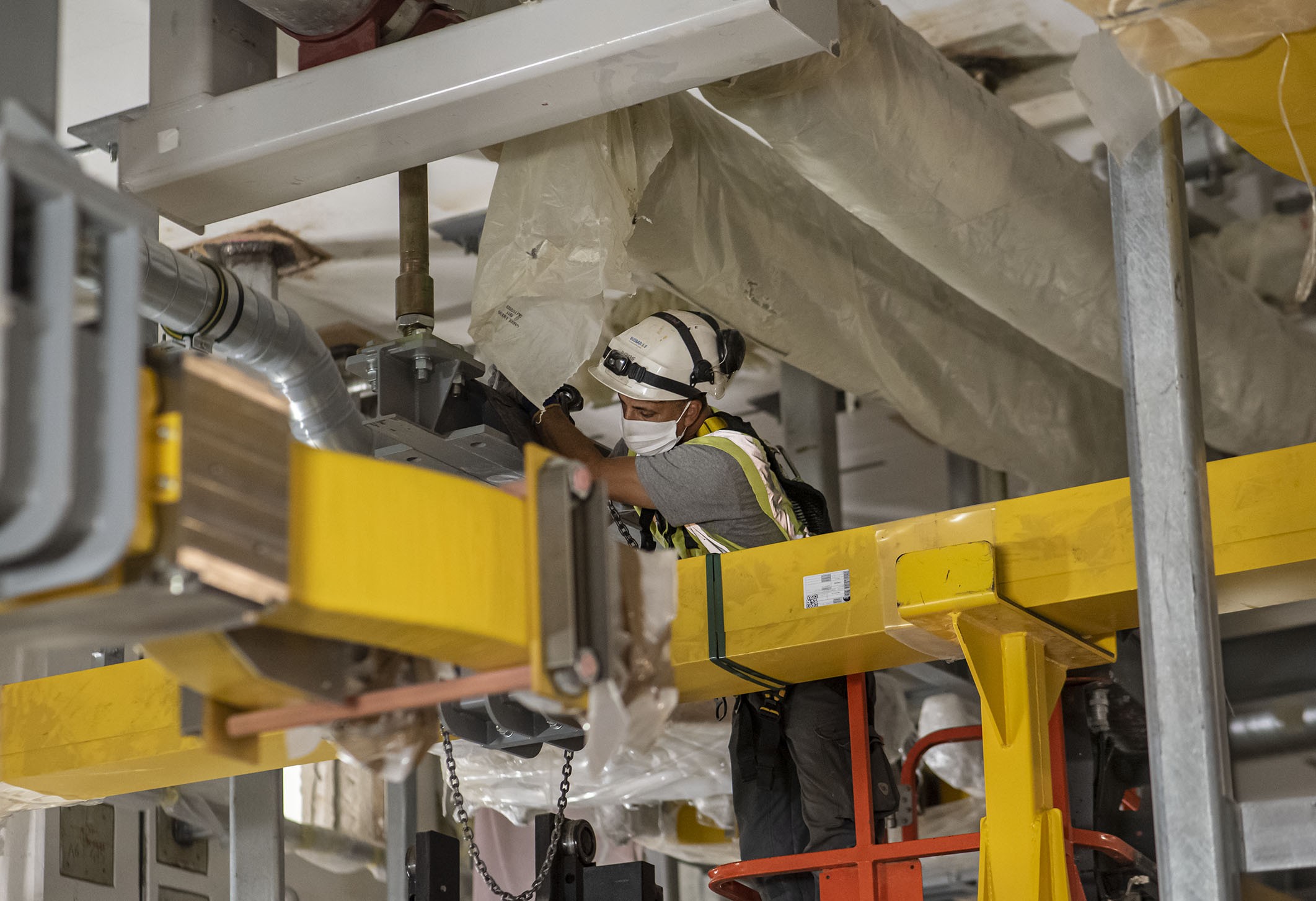
Once bolted to their supports, the long (up to 12 metres) and heavy (up to 4 tonnes) busbar lengths must be connected to one another and to cooling water collectors, and hose connections must be installed before the whole system can be tested and commissioned.
In an environment already crowded with cable trays and all sorts of piping and HVAC ducts, the task is particularly challenging: individual busbar segments are sometimes very long (up to 12 metres) and quite heavy, ranging from 2 to 4 tonnes in weight.
Moving and adjusting the beams into position is a delicate operation that requires the coordinated movements of forklifts and pulley systems before they can be manually bolted to their support.
Once in place, the busbars need to be connected to one another and to cooling water collectors, and hose connections must be installed before the whole system can be tested and commissioned using dummy coils.
Busbar installation in the Diagnostics Building began a little more than two weeks ago and is now approximately 20 percent complete. In 2021, similar operations will be performed at the third floor of the Tokamak Building (L3) to connect another set of poloidal field coils, central solenoid modules and correction coils.