ITER in "Nuclear Fusion": progress, key objectives and the larger ecosystem
ITER in "Nuclear Fusion": progress, key objectives and the larger ecosystem
In a comprehensive new article in Nuclear Fusion, ITER Director-General Pietro Barabaschi and colleagues outline the progress of ITER and reaffirm the project’s central role in bringing fusion energy from experimental science to industrial reality.
After a period of restructuring, contract adjustments, and technical recovery, the project is now advancing under a revised plan known as Baseline 2024, designed as a realistic and achievable path to the first experiments, deuterium operation, and ultimately deuterium-tritium fusion with a gain of Q ≥ 10. Over the past two years, the organization has reported its strongest performance to date, maintaining schedule and cost targets while accelerating assembly and manufacturing activities.
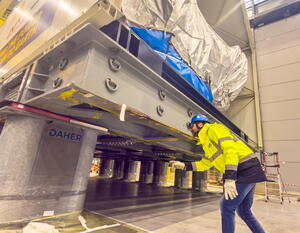
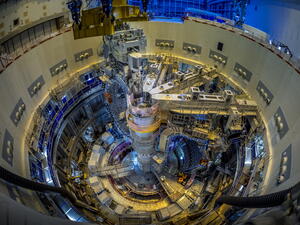
Major milestones include completion of all superconducting magnets, start of series production of tungsten plasma-facing components, and renewed progress in tokamak assembly following successful repairs to key elements. Large plant systems such as the cryogenic infrastructure are operating, and critical test facilities are coming on line as the project transitions from construction to integrated commissioning.
The authors describe how, despite the emergence of new fusion actors, ITER’s mission is unchanged: to demonstrate integrated, industrial-scale fusion and provide the knowledge and technology needed for future power plants. In that sense, they argue, ITER is not competing with the expanding fusion ecosystem—it is laying its foundation.
Barabaschi, P., Artola, F. J., Oliva, A. B., Carannante, G., Coblentz, L., Encheva, A., Giniiatulin, R., Grillot, D., Hunt, R., Jachmich, S., Kamada, Y., Kim, S., Loarte, A., Marquez, A., Merola, M., Noh, C. H., Nunes, I., Orlandi, S., Perrier, G., . . . Veltri, P. (2026). Progress of ITER and its importance for fusion development. Nuclear Fusion. https://doi.org/10.1088/1741-4326/ae4d5c