
Power conversion
China delivers four high-tech transformers
2 Oct 2017
-
R.A.
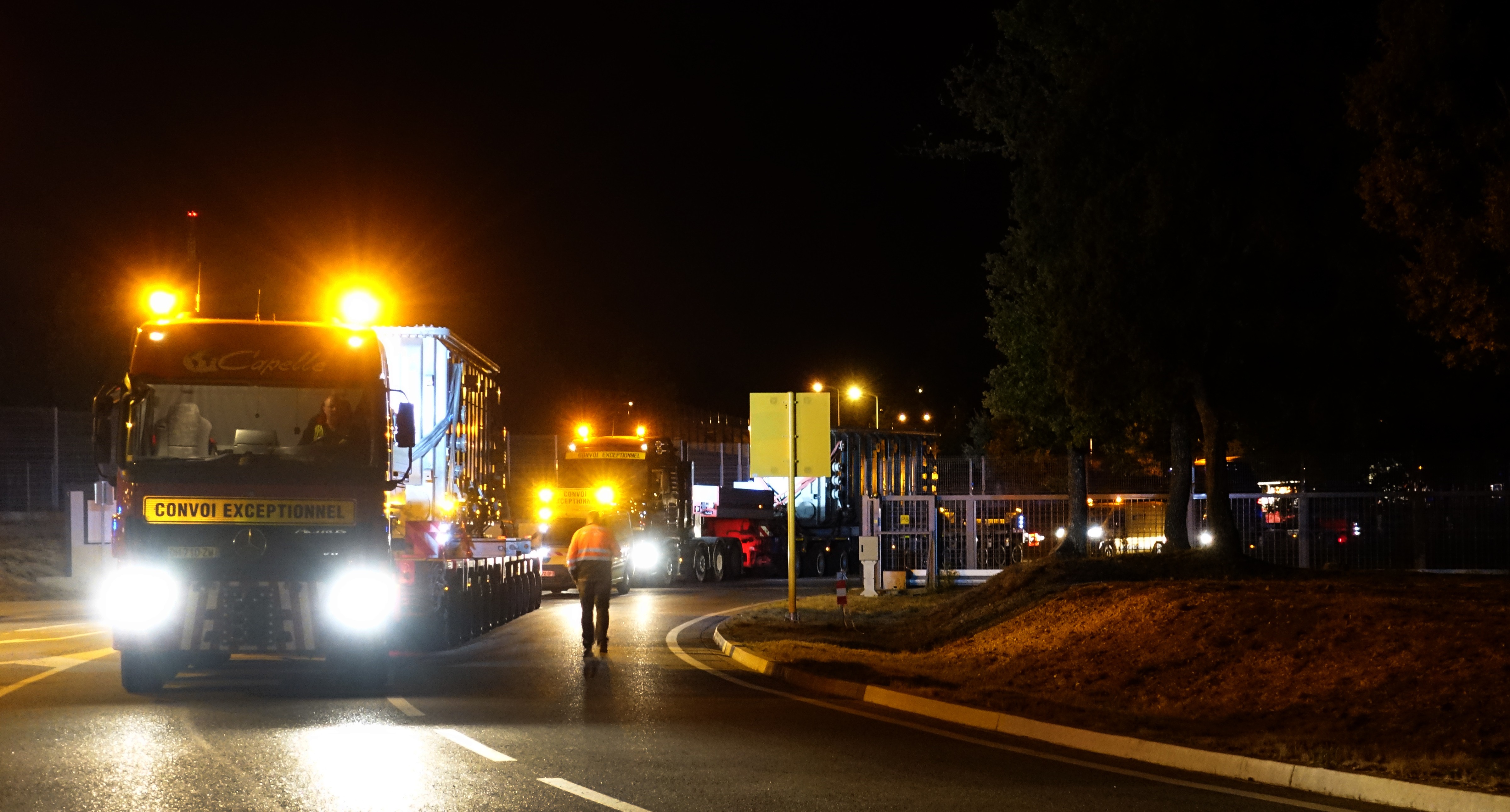
The four converter-transformers that passed the ITER gate at 3:00 a.m. last Wednesday are part of a set of 16 to be installed outside the twin Magnet Power Converter Buildings. (Fourteen are needed for First Plasma, an extra two for subsequent operations.)
Technology for the convertor-transformers draws from four technological know-how: aluminum smelters for high DC current; motor speed drive for current inversion and High Voltage Direct Current (HVDC) power transmission lines for bypass systems.
Procured by China, each of the 128-tonne converter-transformers will be paired to a rectifier and connected to the machine's ring-shaped poloidal field coils. The transformers will bring down the 66 kV AC industrial current to approximately 1 kV; the rectifiers will convert it into DC current, just like a cell phone or laptop adapter transforms the 110 or 220 volts from the wall plug into 9, 12, or 24 volts of DC current.
The difference, as in everything ITER, is in size and power. "With the exception of aluminium smelters, I can think of no industry that requires DC current higher than ITER," says Ivone Benfatto, head of the ITER Electrical Engineering Division.
However contrary to aluminium smelters, the ITER magnets need to be fed current in two directions in order to control the magnetic fields and optimize the duration of the plasmas. "In designing these very challenging components, we have also drawn from the experience in motor speed drive, like the electrical motors that power high-speed trains, whose current needs to be inverted when the train changes direction or when regenerative braking is activated."
And whereas trains can accept interruptions in current transmission, the ITER magnets can't. High voltage direct current (HVDC) power transmission lines and their bypass systems also provided a third input of industrial knowhow to the design of the ITER converter-transformers.
"Sometimes," muses Ivone, "we tend to forget that some of the components that are delivered to us are technological marvels ..."