
Controlling divertor power fluxes in 3D
ITER Scientist Fellows make progress
20 Oct 2020
-
Alberto Loarte, Head of the ITER Science Division
New research results open a path to an integrated solution for optimizing the control of stationary and transient power fluxes on ITER.
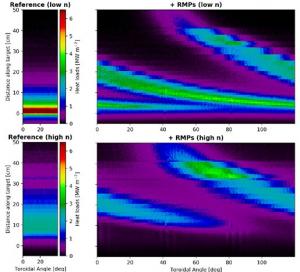
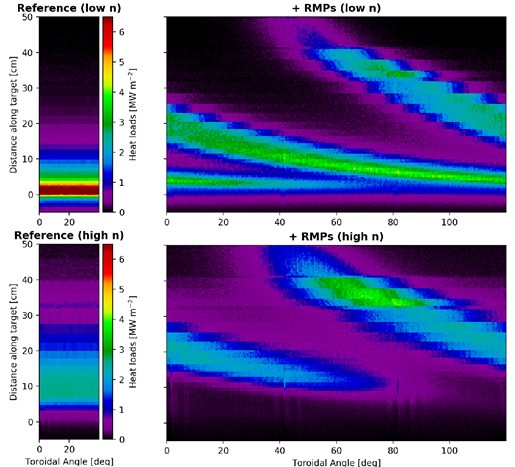
Figure 1: Power fluxes to the outer divertor plasma at low and high plasma density (radiative divertor conditions): 2D toroidally symmetric plasma (left), and 3D edge plasma with a magnetic field modified by ELM control coils (right).
Tokamak plasmas are basically symmetric toroidally—and so are the power loads to the divertor. Power fluxes change with distance along the divertor targets when looking at the cross section of the torus but not in the toroidal direction (Figure 1).
In ITER, these power fluxes are deposited in a very small fraction of the divertor area, so their magnitude can be very large for high-performance plasmas (high Q or fusion gain). Indeed, evaluations from both edge plasma modelling and empirical extrapolations show that, in the absence of mitigation measures, divertor power fluxes can exceed the design guidelines for the ITER divertor plasma-facing components (10 MWm-2) for high Q plasmas.
To reduce these power fluxes, impurities are purposely injected in the divertor plasma to enhance losses by electromagnetic radiation (i.e., the emission of light). This spreads the plasma power flowing down to the divertor over a larger area, thus reducing the local power fluxes to below 10 MWm-2. This so-called semi-detached radiating divertor regime, on which ITER high Q operation is based, is routinely demonstrated in operating fusion experiments.
However, the need to limit power fluxes in ITER goes beyond that of present experiments. In addition to the stationary power fluxes described above, ITER also needs to control transient power fluxes associated with high confinement plasmas (so-called H-modes) that are required for the achievement of high Q.
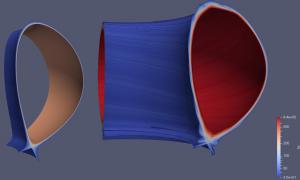
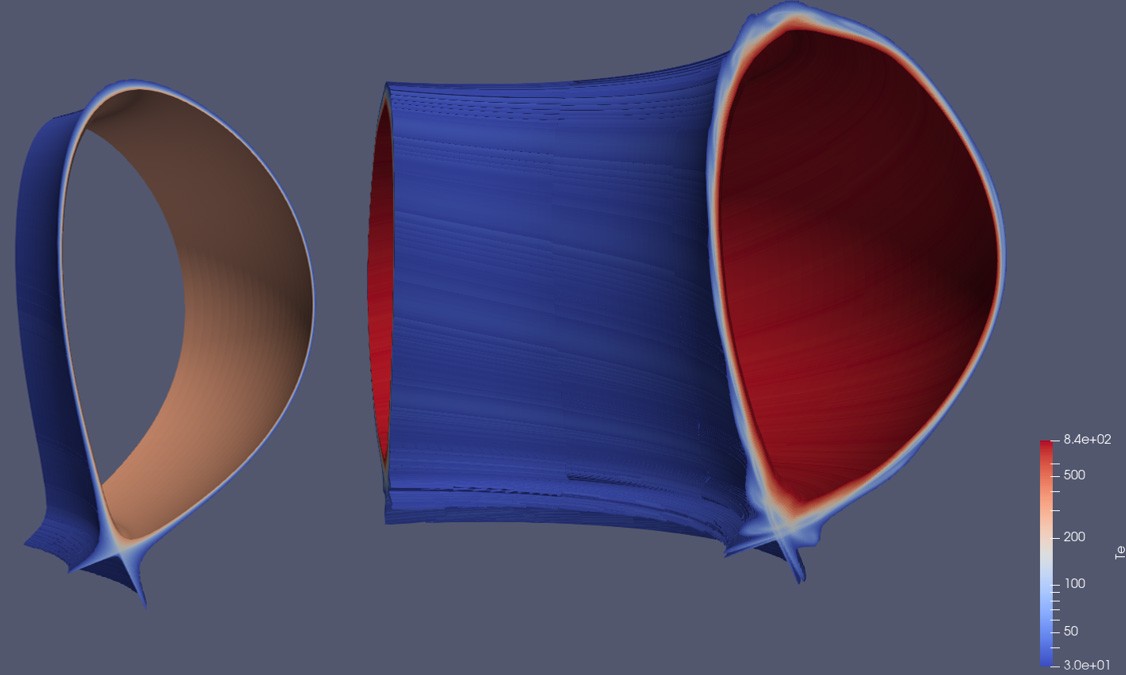
Figure 2: Plasma temperature at the ITER divertor: a 2D toroidally symmetric plasma (left), and a 3D edge plasma with a magnetic field modified by ELM control coils (right).
The specific transients associated with H-mode plasmas are called ELMs (Edge Localized Modes). ELMs cause small losses of plasma energy, but on very short timescales (tenths of milliseconds). In ITER, because of the large plasma energy required to produce fusion power, the associated power fluxes can heavily erode the divertor target, reducing its operational lifetime to unacceptable values.
ELMs need to be mitigated or, even better, eliminated. To achieve this transient power load control, ITER is equipped with a set of 27 in-vessel ELM control coils. By applying electrical currents in these coils, it is possible to modify the edge magnetic field and mitigate or eliminate the ELMs altogether. An unavoidable consequence of this technique, however, is that the edge plasma is no longer toroidally symmetric and thus has a full 3D structure (Figure 2). This can affect the radiative divertor solution which relies on a 2D plasma assumption.
It is therefore necessary to confirm that the 2D stationary and 3D transient power flux control methods, impurity injection, and ELM control coils, can be compatible for the operation of high performance ITER plasmas. Initial experiments in EAST, which used currents at the plasma edge driven by radiofrequency waves to create a 3D structure, showed that indeed 3D edge magnetic fields deeply affect the access to radiative divertor conditions as the plasma density is increased. Near the intersection of the plasma with the divertor target, the power flux decreased with increasing density—similar to the 2D situation. However, far from this intersection, where the plasma power fluxes are non-toroidally symmetric, the power fluxes increased with increasing density.
Following this initial finding, tokamak experiments equipped with ITER-like ELM control coils have studied this issue in further detail (ASDEX Upgrade, DIII-D, EAST, KSTAR, NSTX). Unfortunately, it has not been possible to reproduce the divertor and main plasma conditions that are expected in ITER simultaneously. When the 3D divertor plasma is dense and cold and radiates the plasma power away, as required in ITER, the main plasma is also dense and cool—making the 3D edge magnetic field structure differ from that in ITER and vice-versa. This has prevented the direct extrapolation of present experimental results to ITER and has made another approach to solving the conundrum necessary.
ITER Scientist Fellows and ITER Organization staff involved in the work that was published in Physical Review Letters on 9 October 2020.
This issue was put to the ITER Scientist Fellows—a group of leading plasma modelling experts from the ITER Members supported by their national fusion programs (the US Department of Energy and EUROfusion in this case) and the ITER Organization—and they rose to the challenge. Through the effort of Scientist Fellow specialists in 3D edge plasmas (H. Frerichs, O. Schmitz, and D. Reiter), 3D magnetic fields (Y. Liu), and their collaborators—and coordinated by staff from the ITER Organization Science Division (X. Bonnin, R. A. Pitts, and A. Loarte)—a first understanding of power flux control in ITER's 3D plasmas has emerged.
The results, recently published in Physical Review Letters, show that the qualitative behaviour initially observed in EAST will be reproduced in ITER plasmas, and that this is due to the specific 3D structure of the edge magnetic field that the ELM control coils will create in ITER plasmas (Figure 1, right side).
This understanding provides a way to optimize the control of stationary and transient power fluxes by tuning the 3D edge magnetic fields applied for ELM control in ITER. The ITER ELM control coils have recently concluded their final design review and are capable of providing a wide range of 3D magnetic field structures, including the possibility to rotate them during ITER plasma discharges to allow optimization. The ITER Scientist Fellows and their collaborators had previously studied the optimization of the applied 3D fields for ELM control alone. The new results, achieved through joint effort, open the path to include the divertor plasma in the optimization process to provide an integrated solution for ITER to control the divertor power fluxes.
H. Frerichs, O. Schmitz, X. Bonnin, A. Loarte, Y. Feng, L. Li, Y. Q. Liu, and D. Reiter. "Detachment in Fusion Plasmas with Symmetry Breaking Magnetic Perturbation Fields." Physical Review Letters 125, 155001 (9 October 2020). https://doi.org/10.1103/PhysRevLett.125.155001.